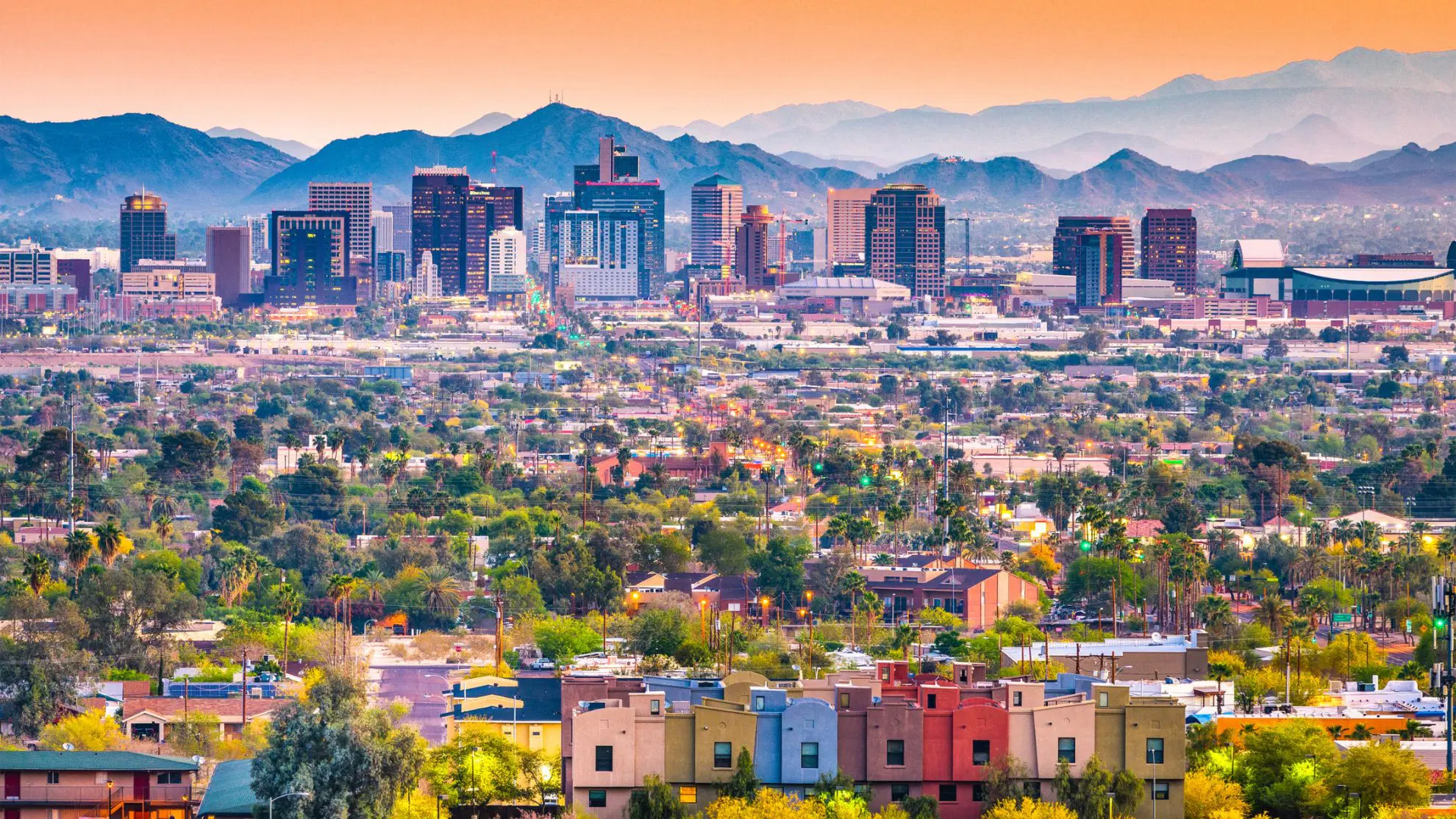
Phoenix is not one venue district but three that happen to share a city name. The Phoenix Convention Center anchors downtown alongside the Sheraton Phoenix Downtown headquarters hotel, Chase Field and Footprint Center sit a few blocks away on the arena side of downtown, and the Arizona State Fairgrounds occupies its own campus off 19th Avenue and McDowell Road, several miles northwest. A show that books the wrong district on assumption alone often ends up fighting freeway traffic between hotel blocks and load-in docks that were never close together to begin with.
The drive from Scottsdale into downtown Phoenix runs about twenty to twenty-five minutes on Loop 101 to State Route 51 to Interstate 10, shorter outside peak commute windows and longer during the Monday and Friday freeway crush that any multi-day install schedule has to plan around. The fairgrounds corridor adds another ten to fifteen minutes beyond downtown depending on which exit is used, which matters for crews shuttling between a Scottsdale staging yard and a Phoenix dock more than once a day.
Because Phoenix carries this much venue variety under one name, the planning conversation starts with which sub-district actually fits the show: a trade show floor wants the convention center, an arena activation wants Chase Field or Footprint Center, and a large agricultural, consumer, or expo-style format is usually better served by the fairgrounds' multiple exhibit buildings than by squeezing into a downtown hall built for a different footprint.
Execution priorities
- Exhibit hall booking at the Phoenix Convention Center
- Headquarters hotel logistics at the Sheraton Phoenix Downtown
- Arena-scale builds at Chase Field and Footprint Center
- Expo-format layouts across the Arizona State Fairgrounds campus
- Freeway and dock-to-dock routing between Scottsdale and Phoenix
How Phoenix fits the Scottsdale-based program map
Most shows that touch Phoenix are still run out of a Scottsdale base, since that is where hotel inventory, exhibitor housing, and rental warehouse space tend to concentrate. Phoenix itself supplies the larger convention and arena floors that Scottsdale's resort ballrooms cannot match in raw square footage, so the two cities function together: Scottsdale for lodging and smaller breakout meetings, Phoenix for the main exhibit hall or arena floor.
That division only works cleanly if the routing between the two is planned rather than assumed. A schedule that has crews commuting from a Scottsdale hotel to a downtown Phoenix dock every morning needs a realistic call time, and one that has trucks running from a Scottsdale warehouse to the fairgrounds needs a different route entirely than the one that serves the convention center.
Downtown Phoenix Convention Center logistics
The Phoenix Convention Center is the default answer for a trade show or conference that needs true exhibit-hall square footage, meeting rooms stacked above the show floor, and light rail access that lets attendees skip parking entirely. Dock access runs off the building's service streets rather than a single loading yard, so drayage schedules need to reference the specific hall being used, rather than only the building name.
Because the center sits inside the downtown grid, street closures for concurrent events, ballgame traffic on Chase Field or Footprint Center nights, and normal weekday congestion all affect how tightly a load-in window can be scheduled. A Tuesday morning dock slot behaves very differently from a Friday evening one when a Suns or Diamondbacks game is also drawing traffic into the same few blocks.
Sheraton Phoenix Downtown as headquarters hotel
The Sheraton Phoenix Downtown sits close enough to the convention center for attendees to walk between sessions and the show floor, which makes it the natural headquarters hotel pick for a program anchored there. Room block negotiations and general session space inside the hotel need to be coordinated against the convention center's own meeting room calendar so the two don't compete for the same dates.
For programs that also need overflow meeting space or a smaller executive breakout separate from the main show floor, the hotel's own function space is usually easier to secure on short notice than additional convention center rooms, which get booked well in advance by larger citywide events.
Arena-scale builds at Chase Field and Footprint Center
Chase Field and Footprint Center serve a different kind of Phoenix program: large-format activations, product launches, and branded experiences that want an arena floor or concourse rather than a conventional exhibit hall. Both venues set their own load-in rules based on game-day schedules, so a build date has to be checked against the Diamondbacks and Suns calendars before anything else gets locked in.
Rigging, power drops, and floor protection requirements differ meaningfully between the two buildings and from the convention center, so a crew that has only worked convention-hall builds needs a specific walkthrough of either arena before committing to a install timeline.
Expo-hall capacity at Arizona State Fairgrounds
The Arizona State Fairgrounds campus off 19th Avenue and McDowell Road holds several separate buildings, including Veterans Memorial Coliseum, the Exhibit Building, Grandstand Arena, the Agriculture Center, the Home Arts Center, and the Wesley Bolin Building, plus outdoor space like Arizona Plaza. That mix makes the fairgrounds a better fit than downtown for shows that need large open floor area, outdoor demonstration space, or multiple simultaneous halls under one gate.
Because the fairgrounds is a standalone campus, parking and surface-lot load-in are generally easier to schedule than a downtown dock, but the tradeoff is distance: it sits far enough from the convention center and hotels that a split program needs a shuttle plan, not a walk.
Freight, drayage, and dock scheduling across Phoenix venues
Each of these Phoenix venues has its own drayage rules, dock hours, and preferred general contractor relationships, so a freight plan built for the convention center rarely transfers cleanly to the fairgrounds or an arena without adjustment. Advance warehouse routing needs to specify which building is receiving freight, since Phoenix's total venue footprint is too spread out for a single generic drop-off instruction to work.
Material handling rates and forklift availability also vary by venue, which is worth confirming early rather than assuming downtown pricing applies to a fairgrounds booking or the reverse.
Drive times and routing from Scottsdale
The most reliable route from central Scottsdale into downtown Phoenix runs Loop 101 south to State Route 51 south to Interstate 10, landing near the convention center in roughly twenty to twenty-five minutes off-peak. The fairgrounds adds distance west, typically thirty to thirty-five minutes total from central Scottsdale.
Morning and evening commute windows extend both routes noticeably, so a crew call time that looks fine on a map needs a buffer for actual freeway conditions, particularly on days when a Chase Field or Footprint Center event is also pulling traffic into the same downtown exits.
Labor, crew staging, and parking realities
Downtown Phoenix parking runs through paid garages near the convention center and arenas, with rates that climb on event nights, while the fairgrounds relies on its own surface lots that are generally more predictable but farther from a walkable hotel district. Crew staging plans should account for which of these applies before locking a call sheet.
Local labor coordination differs by venue too, since each maintains its own preferred labor relationships, and a show moving between them in the same week needs that distinction built into the schedule.
Choosing the right Phoenix venue for a given show
The practical starting question for any Phoenix booking is which of the three districts the format actually needs: exhibit-hall square footage with meeting rooms above it points to the convention center, an arena floor or concourse activation points to Chase Field or Footprint Center, and a large expo or consumer-facing format with outdoor space points to the fairgrounds.
Once that choice is made, the hotel block, freight plan, and crew routing should all follow the same district rather than defaulting to whichever hotel or dock was used on a previous Phoenix show, since the three districts do not share infrastructure closely enough to swap freely between them.
Frequently asked questions
Which Phoenix venue should a trade show book first?
For a conventional exhibit hall with meeting rooms and light rail access, the Phoenix Convention Center is the standard choice. It pairs directly with the Sheraton Phoenix Downtown as headquarters hotel and works well for programs that already run their room block out of downtown.
Is the Arizona State Fairgrounds a realistic option for a corporate trade show?
Yes, particularly for large-footprint or outdoor-inclusive formats. The fairgrounds campus includes Veterans Memorial Coliseum, the Exhibit Building, Grandstand Arena, and several smaller buildings plus outdoor plaza space, giving it more raw floor area than most downtown halls, though it sits farther from hotel inventory.
How far is downtown Phoenix from a Scottsdale hotel base?
Roughly twenty to twenty-five minutes off-peak via Loop 101 to State Route 51 to Interstate 10. That window extends during morning and evening commute periods and on nights when Chase Field or Footprint Center is also hosting an event downtown.
Can a program use Chase Field or Footprint Center for a non-sporting event?
Both venues host branded activations, product launches, and large corporate events outside their regular game schedules, but availability is built entirely around the Diamondbacks and Suns calendars, so booking has to start there before any other planning.
Do the convention center, the arenas, and the fairgrounds share the same freight and drayage rules?
No. Each venue sets its own dock hours, drayage rates, and preferred general contractor relationships, so a freight plan for one does not automatically transfer to another. Advance warehouse routing should name the specific building receiving freight.
What is the biggest planning mistake for a program that spans Scottsdale and Phoenix?
Treating the two cities as one commute-free zone. Scottsdale supplies hotel and breakout space while Phoenix supplies the larger exhibit or arena floor, and any schedule connecting them needs realistic freeway time built in, especially around downtown event traffic.